
Structure is Everything LLM-Friendly SEO Series Part 1
We are witnessing a fundamental shift in how the internet is indexed and served. For two decades, we optimized for spiders—crawlers that scanned for keywords and backlinks.

Author
Bryan Mull
Date
Category
SEO/GEO

Introduction
We are witnessing a fundamental shift in how the internet is indexed and served. For two decades, we optimized for spiders—crawlers that scanned for keywords and backlinks. Now, we are optimizing for Large Language Models (LLMs) like ChatGPT, Gemini, and Claude. These models don’t just match keywords; they attempt to understand context, intent, and relationships. If your site structure is messy, you aren’t just losing rank; you are becoming invisible to the engines answering your customers’ questions.
Most agencies and development teams treat site structure as a visual concern or a basic SEO checklist item. They worry about whether the navigation menu looks good on mobile or if the H1 tag matches the page title. While important, this surface-level approach ignores the underlying architecture that LLMs rely on to process information. When an AI model scrapes your Magento store, it isn’t looking at your CSS. It is parsing the raw DOM structure to figure out if your product is a “luxury watch” or just a collection of unassociated text strings about gears and straps.
Structure is the primary language of these models. Without strict semantic organization, your content is just noise. We have spent years fixing technical SEO disasters where beautiful Magento sites performed poorly because the underlying code was a mess of unstructured data. Now that AI is becoming the primary interface for search, that technical debt is more dangerous than ever.
Machine-Readable Formats Are Not Optional
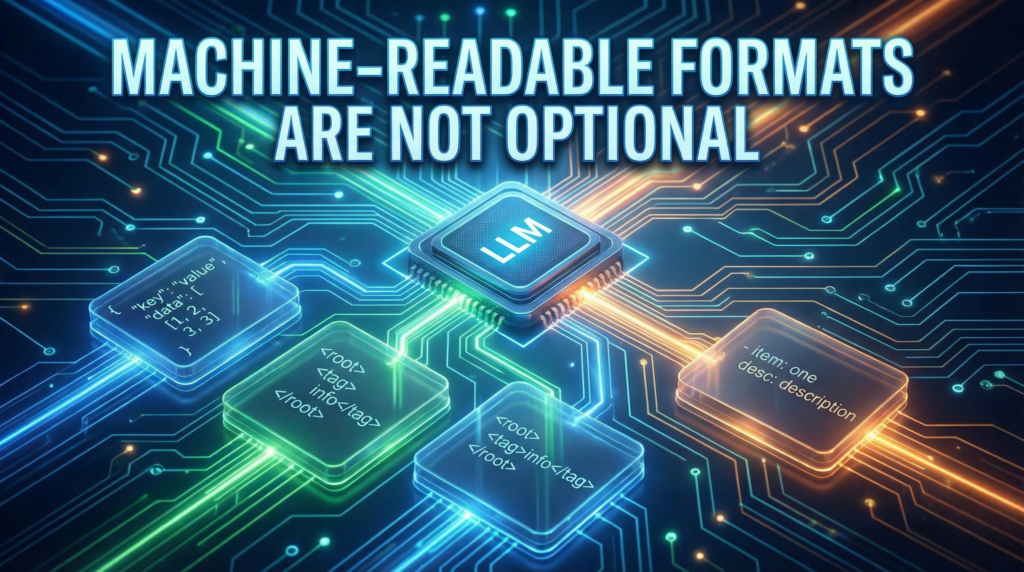
The first step in LLM optimization is recognizing that text on a page is the least efficient way for a machine to learn about your products. LLMs prefer structured, machine-readable formats. In the context of e-commerce, this means going beyond basic HTML.
We often see development teams rely solely on visual presentation to convey product specifications. They put dimensions, materials, and care instructions in a generic text block. To a human, that works. To an LLM, it requires inference, which introduces error. You need to present this data in formats like JSON-LD (JavaScript Object Notation for Linked Data). When you explicitly define your product attributes using standard schemas, you allow LLMs to parse that information programmatically.
For Magento stores, this is critical. Your catalog likely contains thousands of complex relationships—configurable products, bundled items, and related accessories. If this data is locked inside unstructured paragraphs, AI search tools cannot confidently recommend your specific part for a specific customer query. We implement comprehensive schema markup that defines not just the product, but the relationships between entities. This removes the guesswork for the model.
The Problem with “Div Soup”
Modern frontend development often falls into the trap of “div soup”—nesting endless generic <div> tags to achieve a specific layout. While this might render perfectly in a browser, it strips your content of semantic meaning.
LLMs use HTML5 semantic elements to understand the hierarchy and importance of content. Elements like <article>, <section>, <nav>, <aside>, and <figure> tell the model exactly what role a piece of content plays. A <nav> tag indicates high-level site architecture, while an <aside> might indicate tangential information. If everything is wrapped in a generic div, the AI has to guess what matters.
We frequently audit Magento themes where the main product description shares the same structural weight as the footer links or the “related products” widget. This flattens the content hierarchy. When we restructure these templates to use proper semantic HTML, we aren’t just cleaning up code; we are providing a map for the AI to understand what the page is actually about. This distinct structural clarity allows LLMs to extract the core value proposition of your page without getting distracted by the noise of the interface.
Hierarchy Is Context
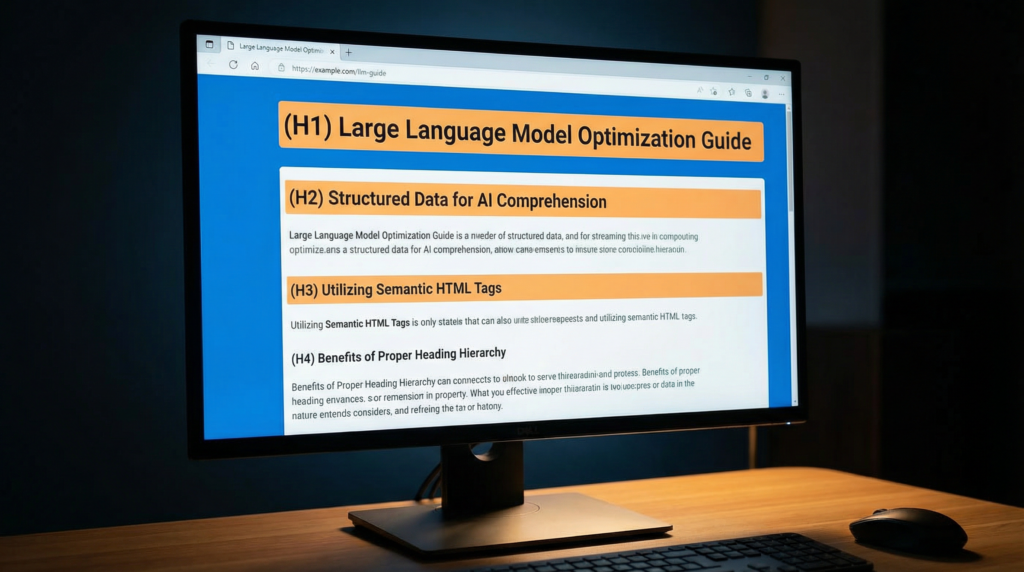
Beyond the tags themselves, the logical hierarchy of your content dictates how an LLM interprets importance. This goes deeper than just putting keywords in an H1 tag. It requires a strict parent-child relationship in your document structure.
Your H1 through H6 tags form the outline of your argument or product presentation. If you skip from H2 to H4 because you prefer the font size of the H4, you break that logical tree. LLMs use these headers to construct a mental model of your content. They assume that content under an H2 supports the H2, and content under an H3 supports the H2 above it. Breaking this chain confuses the model regarding which details belong to which concept.
In our technical audits, we often find heading structures that follow visual design patterns rather than logical ones. A “You Might Also Like” section shouldn’t visually dominate the technical specifications of the main product, nor should it structurally appear as the primary topic. By aligning your document object model (DOM) with the logical priority of information, you ensure that when an LLM summarizes your page, it captures the critical details rather than the marketing fluff.
Metadata as Training Data
Finally, we need to rethink metadata. Historically, meta descriptions were just ad copy designed to get a human to click a link on a search results page. In the age of GEO (Generative Engine Optimization), metadata provides context for the model itself.
Comprehensive metadata—including Dublin Core elements, Open Graph tags, and Twitter Cards—serves as explicit labeling for your content. It tells the LLM definitively who wrote the content, when it was published, and how it relates to other entities. This is particularly important for establishing authority. If an LLM is trying to decide whether to trust your technical guide on “Magento 2.4.6 indexing issues,” explicit authorship metadata helps it verify the source’s credibility.
We see this as the difference between an organized warehouse and a pile of inventory. You might have the best products in the world, but if they aren’t labeled and shelved according to a system the picker understands, they won’t ship. LLMs are the new pickers. If you want them to serve your content to users, you must provide the structural labels they require.
This shift toward structure-first SEO isn’t just about future-proofing for AI. It solves immediate problems regarding crawlability and indexation that plague many large Magento catalogs today. The cleaner your structure, the easier it is for Google—and its AI—to understand why your store matters.
Ready to ensure your Magento store is accessible to LLMs?